

The Body Knows
The body keeps the score — and tells the truth.

If you are a woman anywhere near midlife, there is a moment your body starts telling the truth whether you want to hear it or not. It might show up as exhaustion you can’t shake, or anxiety humming under the surface most days. Sometimes it’s a tightness in your chest when you walk into a room that used to feel perfectly fine. I probably don’t need to explain that sleep weirdly rides off into the sunset. Another example: there are two people that text me, and when those names pop up, my stomach drops every time, no exceptions.
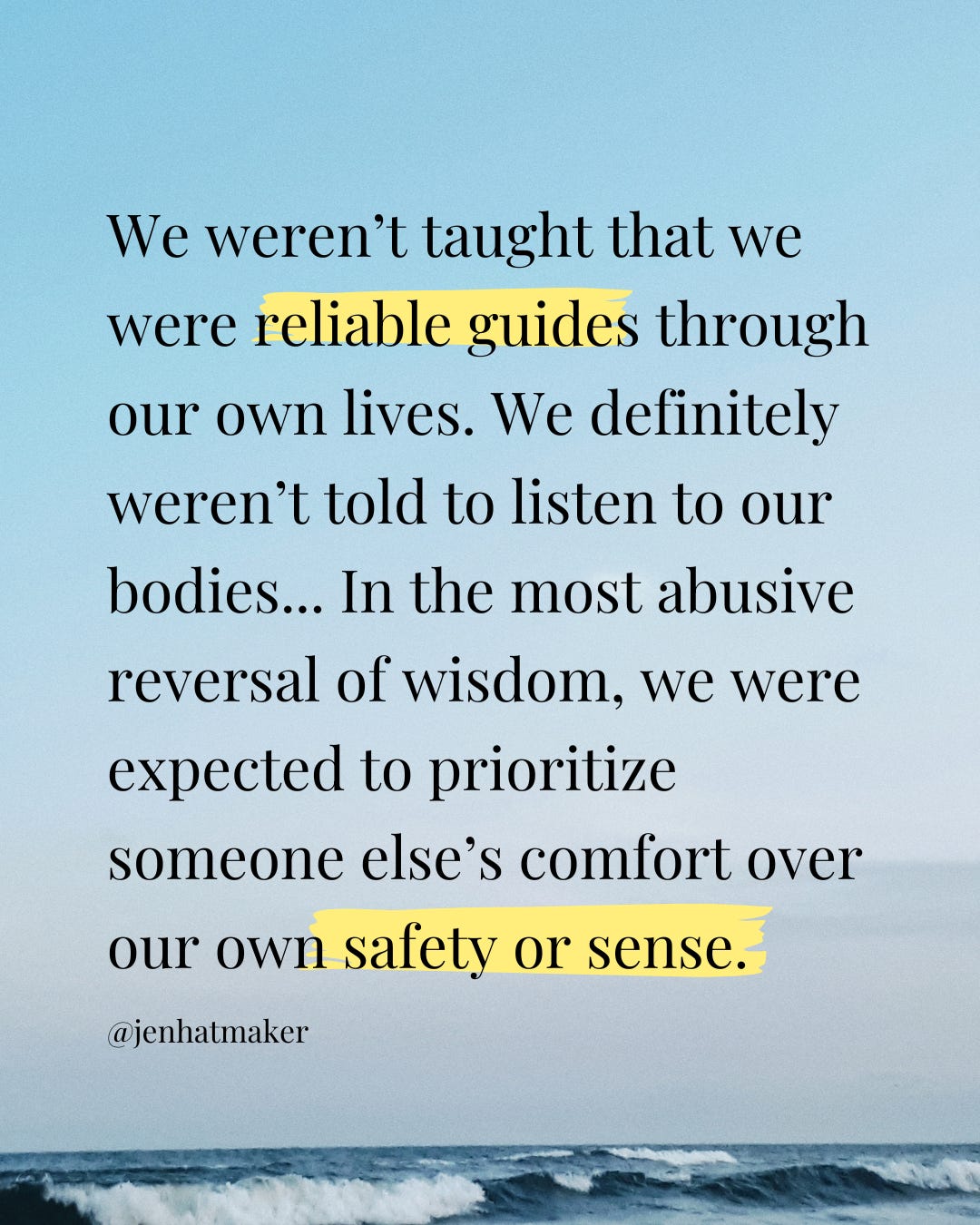
Maybe you keep brushing off the same feeling in your gut, or temples, or chest, or strangely like me, the backs of your hands (idk, guys) that says something here is not right. For a long time, most of us try to override it, because we were trained to. We weren’t taught that we were reliable guides through our own lives. We definitely weren’t told to listen to our bodies; they were cast as hysterical, emotional, way too feminine to be trusted for self-governance. In the most abusive reversal of wisdom, we were expected to prioritize someone else’s comfort over our own safety or sense.
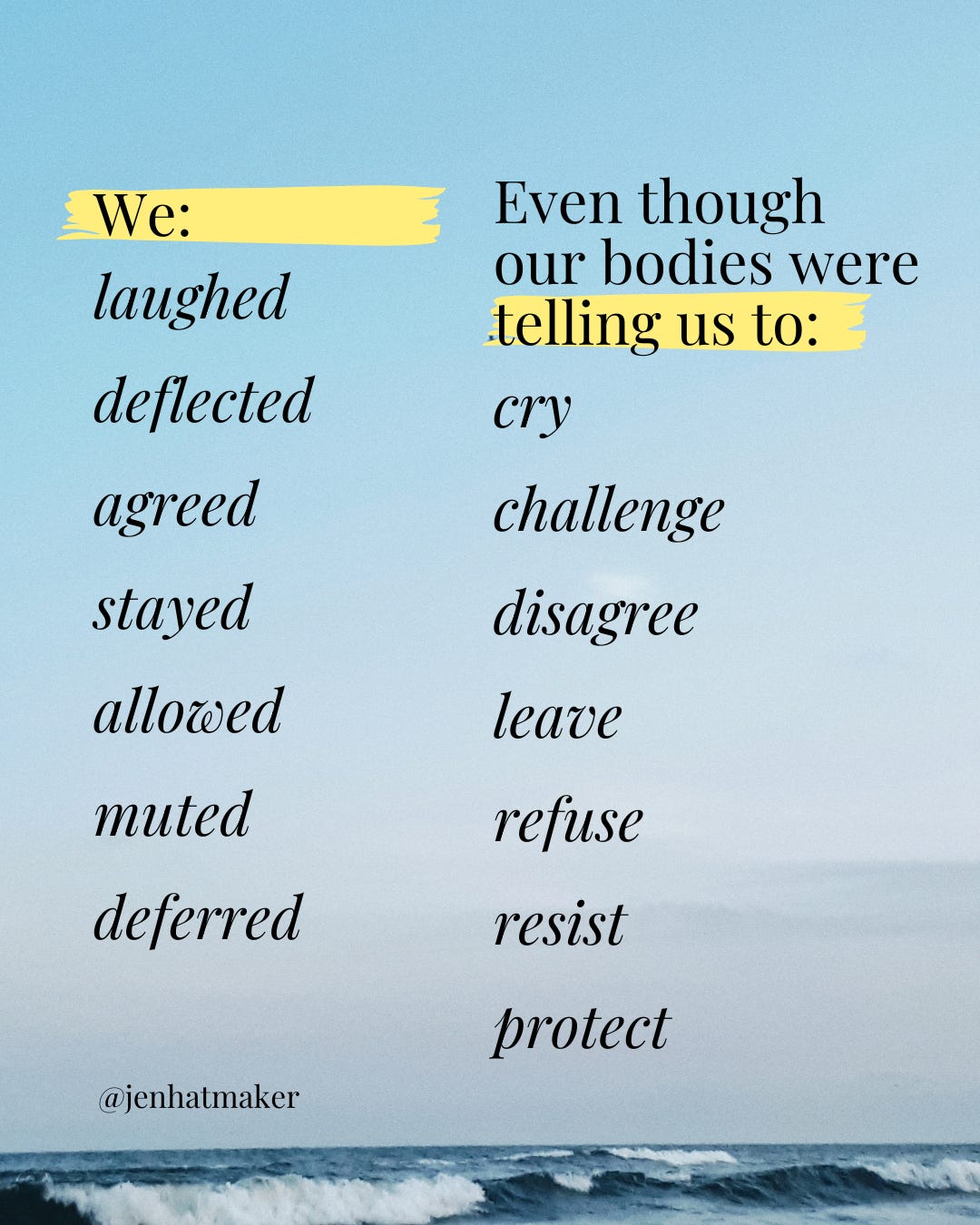
So we:
laughed
deflected
agreed
stayed
allowed
muted
deferred
Even though our bodies were telling us to:
cry
challenge
disagree
leave
refuse
resist
protect.
We “kept the peace” at the expense of our own.
Of course, we had to broker negotiations with our bodies to make that work. Silencing a blaring alarm bell takes some finesse, after all. So we told ourselves we were just tired, or hormonal, or having a weird week. We doubled down on responsibility and grit and caffeine and sheer determination. We talked ourselves out of embodied wisdom and created alternative culprits: cedar allergies, ovulation, a full moon. “You’re fine,” we told ourselves. “Just get through this month.”
For a while, the body let us get away with it.
But eventually, the body stops negotiating.
As I wrote in Awake, the year my life unraveled, my nervous system reached the end of what it could carry. My marriage was ending, my family was reeling, and my world collapsed in ways I was too stunned to process. Like so many women do, I raced straight into survival mode. I ran on adrenaline for almost a year and held everything together the only way I knew how: by powering through. I was parenting, managing compounding crises, and piloting everyone else while quietly convincing myself that I was fine.
But my body knew better.
The gig was up the day I managed the last-straw crisis and landed in the ER with catastrophic blood pressure and a complete breakdown. I was crying. Shaking. Soaked in sweat from my first panic attack. And against every conceivable piece of evidence, I looked my doctor directly in the face and told him, quite sincerely, with tears dripping off my chin:
“I am actually really strong.”
My god. The disassociation was unhinged. He listened with such patience and care, a tenderness I will never, ever forget. He patted my knee and said something that changed the way I understand my body forever:
“Jennifer,” he said gently, “your body has done so much. It worked overtime on adrenaline to get you through this year. It’s simply telling you it can’t do any more.”
Not that I had failed.
Not that I was weak.
Just that my body had reached the end of what it could carry.
Honestly? That was the first time I felt compassion for my own nervous system. Instead of seeing my body as the problem, I saw her for what she had been all along: my partner and protector. She was the loyal friend who carried me through the fire and got us so far. Now she insisted that I listen to her, because I’d pushed us beyond capacity.
The older I get, the more I see this pattern in women everywhere. At some point in midlife, we ask a different question. Not: Can I survive this? But: Do I want to keep surviving like this?
During a Wake Up Call conversation, I hosted researcher and author Emily Nagoski, and she said something that cut through the fog: women reach a point where they begin to “budget what their body can tolerate.”
In other words, the question quietly becomes:
Can my body live like this for another decade?
Once that question enters the room, everything starts to change, because budgets are limited and have to be managed. Our capacity is actually finite, and once we start paying attention to what our body is saying, certain truths become impossible to ignore.
Emily also pointed out something we experienced without realizing it: when we were younger, our bodies were better at masking the cost of pushing ourselves too hard. We could run on stress and adrenaline for years without (fully) feeling the toll. But every time we override those signals, we pay a small price, and eventually, those costs accumulate. Until one day our body quietly says:
I’m done carrying this.
For years, I treated my body like a machine that could (should?) always find a way to get it together. If she panicked, I bossed her to calm down. If she was exhausted, I told her she could sleep when she was dead. If she protested, I reminded her of our responsibilities and asked her who the hell else would do it all.
But healing taught me something different: My body is not the weak link in an otherwise sturdy mental chain. She is the trustworthy matriarch and first responder. She is the wise mother of this operation whose sum is greater than her parts. Her knowledge is ancient and born from generations of strong women. While my ego chases after fleeting shiny objects, my body is in tune with nature and rhythms and spirit and God. When she speaks, it is with credible authority. Her source material is intuition and a deep understanding of truth, goodness, danger, safety, justice, courage. She is not altered by algorithms or triggered by trends. She doesn’t speak out of fear. She understands limits. She knows what to do. She always knows what to do.
Your nervous system has been working overtime since the day you were born, scanning the horizon for belonging and rejection, love and loss. Your body holds memories your mind cannot articulate. She remembers grief you buried, fear you minimized, and joy you forgot you deserved. Your body is always paying attention even when you aren’t, sometimes especially then.
One of the most powerful experiences I wrote about in Awake happened during a healing ritual called Closing the Bones. The practice comes from traditional Mexican postpartum care. Women wrap long shawls called rebozos around a woman’s body and pull them tight on either side, rocking her slowly. It’s meant to help the body “close” after a major life transition, typically childbirth. It signals the end of fight-or-flight and gently welcomes you back into your body. New mothers have long understood its power; labor and delivery deserves closure.
So does divorce.
So there I was, wrapped tightly in these long shawls while a traditional healer sang softly over me, and suddenly my body panicked. I mean, panicked. I couldn’t move my arms even an inch inside the rebozos. My heart started pounding. My breathing turned shallow. Sweat drenched my whole body in five seconds. My nervous system reacted instantly long before my mind understood what was happening.
Because for a moment as I internally processed my immense losses, I felt like I was being wrapped for burial. In a way, I was. It was my moment to bury the dream of my marriage, my future as I’d expected. It was a funeral. My body was only reacting appropriately; who doesn’t cry at funerals? Especially of such a beloved dream? Physical bereavement is fitting. My body overrode my mind and led me toward closure through the only meaningful path: grief.
Then the healer leaned close and said something I will never forget:
“Jen,” she whispered, “you are safe in your body.”
And just like that, breath by breath, my nervous system began to settle. What felt like confinement began to feel like comfort. My body moved out of fight-or-flight and into something I hadn’t felt in a long time: safety. It was the strangest and most beautiful realization. My body had been holding my grief, and now she was releasing it. She was closing the bones. I will never get over the experience.
Back to that Wake Up Call conversation. Emily Nagoski said something that perfectly captured this truth:
“There is always a side door out through our bodies.”
In other words, the body that holds our stress also holds the path back to ourselves. The same nervous system that sounds the alarm can also guide us back to a safe harbor. The same body that collapsed under too much weight eventually teaches us how to stand back up with better boundaries.
If you are in a season where your body feels loud, anxiety humming under the surface or exhaustion following you everywhere or your gut whispering hard truths, I want to say something gently: You are not broken. Your body is not malfunctioning. She might simply be telling the truth. If that particular truth feels inconvenient, or disruptive, or wildly inconvenient for the life you thought you were supposed to live—well, welcome to the club.
Sometimes awakening begins exactly there. Not in your mind or plans, but in your very good body. Perhaps it is time to end the negotiations and finally listen and believe her, because she has been paying attention the whole time.
She knows the way home.
Pause + Reflect
1. Where is your body speaking the loudest right now—and what might it be trying to tell you?
(Not what you think is happening. What are you actually feeling—tightness, fatigue, dread, restlessness?)
2. What have you been pushing through that your body is quietly (or not quietly) resisting?
Name the pattern. The place. The person. The pace.
3. If you asked your body, “Can you keep living like this?”—what would the honest answer be?
Don’t edit it. Let the first response stand.
4. Where might your body be asking for a boundary that your mind keeps negotiating away?
What would it look like to honor that boundary—even imperfectly?
5. Where has your body already told you the truth—and you’re still hoping it might change its mind?
Stay Awake With Us
If something in this piece stirred something in you, that’s exactly why I created The AWAKE Collective.
It’s a quiet, ongoing space on Substack for women in midlife who are paying attention — not to fix themselves, but to stay awake in real life.
Inside The AWAKE Collective, you’ll receive:
Monthly Awake Videos — grounded check-ins to help you orient to the season you’re in
Monthly Live Gatherings — honest conversations and light coaching
Monthly Reflection Kits — gentle prompts and practical tools for real life
Private Community Conversation — a members-only space to process without pressure
Weekly Substack essays + bonus voice notes shared more personally and more deeply
The AWAKE Collective is included with a paid subscription to Letters from the Middle for $8/month (cancel anytime).
There is room for you.
Well, this just spoke directly to my soul-center.
Reading this from the bathroom where I’ve been trapped more than I’d like this year by stress-induced IBS. 😅 Thanks for this thought-provoking piece and the questions at the bottom. I need to sit with this today. (Preferably not on the toilet. Also, TMI? Who, me?!)